
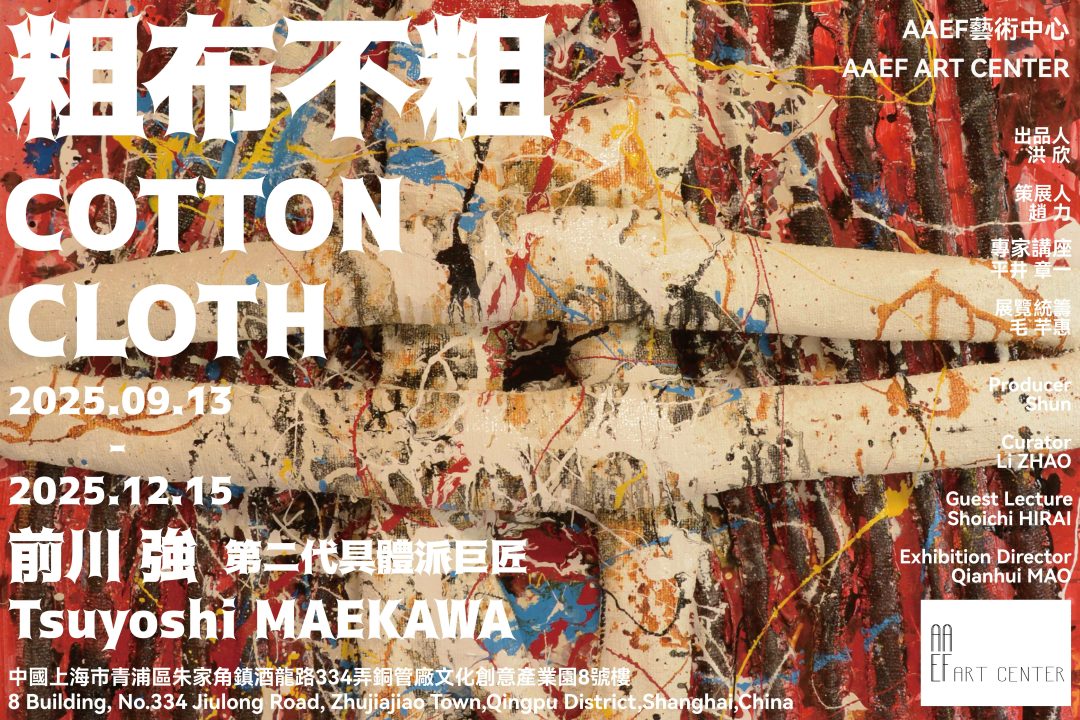
This autumn in Shanghai, the AAEF Art Center will present the exhibition Cotton Cloth, a comprehensive survey of over seventy years of artistic practice by second-generation Gutai artist Tsuyoshi Maekawa, tracing the trajectory of his work and providing a key case study for the research of the Kansai-based Gutai Art Association (GUTAI) active in the 1950s. Through 52 works, the exhibition showcases Maekawa’s distinctive approach—transforming coarse-textured cloth into folds and creases that undulate into patterns reminiscent of classical motifs and natural forms, channeling their inherent force and beauty. His unique technique transforms painting into a “life field,” embodying the Gutai principle of “direct dialogue with matter.”
Since the mid-20th century, postwar Japanese art has undergone a dramatic shift from traditional constraints to avant-garde experimentation. Founded in 1954 by Jiro Yoshihara, the Gutai Art Association emerged as a central force in this transformation, advocating the creation of “what has never been done before” and exemplifying the artist’s freedom of spirit. Born in 1936, Maekawa began studying under Yoshihara in 1959, and debuted in the 8th Gutai Exhibition at the Kyoto Municipal Museum of Art. He officially joined the Gutai Art Association in 1963 and held his first solo exhibition at the Gutai Pinacotheca. As one of the representative figures of Gutai’s second generation—together with TakesadaMatsutani and Shuji Mukai—Maekawa was nicknamed “3M” for the shared initial of their surnames. In 1966, the three held a joint exhibition in the same space. Until the dissolution of the Association in 1972 following Yoshihara’s death, Maekawa remained an active participant in every Gutai exhibition.
During the Gutai period, Maekawa adopted coarse burlap as his primary medium, harnessing the raw material energy of the fabric while also addressing the pictorial properties of his works. He cut, gathered, and stitched the burlap, or adhered it with Bond adhesive, stretching and flattening the gathered edges to create aerial, topographical forms. In terms of color, he maximized the interplay between the material’s tactile surface and painterly expression by splashing, dripping, and staining oil paint across the textured burlap. This approach amplified the material’s natural resilience and malleability, producing works imbued with both strength and fluidity—evocative of the rhythms of earth and nature, and suggestive of meandering riverbeds or the veins of leaves. Structurally and formally, his works also resonate with the bold, primitive patterns of Japan’s Jōmon-period ceramics, revealing an aesthetic grounded in raw and weighty beauty.
After the Gutai group disbanded in 1972, Maekawa entered a transitional phase, abandoning his earlier style. He adopted lighter fabrics, drastically reduced his use of color, and turned to exploring the physical elasticity of the cloth itself—transforming this property into a calmer, more geometric abstract sensibility. In the 2000s, he made a radical break from his signature gathered-and-stitched technique, creating new paintings where folds, protrusions, and negative space together constructed the pictorial image. In recent years, even in his ninth decade, the artist has maintained remarkable creative vitality. His works have returned to an emphasis on material essence, becoming more minimal and transcendental, and even breaking personal boundaries by experimenting with techniques associated with fellow second-generation Gutai artist Takesada Matsutani—something, Maekawa humorously admits, he would never have dared during Yoshihara’s lifetime.
This exhibition presents works spanning from 1965 to the present, with a focus on significant pieces created after the dissolution of Gutai. It examines the evolution and development of Maekawa’s practice in the post-Gutai era, outlining a path of relentless self-renewal. His trust in the inherent nature of materials and his continual pushing of personal limits vividly exemplify the Gutai spirit of “doing what no one has done before.” The exhibition not only addresses Maekawa’s enduring inquiries into the “boundaries of painting” and the “life of matter,” but also proposes the creative trajectory of “from opposition to coexistence with matter,” offering new perspectives and dimensions for understanding the development of contemporary art in Asia.
■Exhibition Overview
Exhibition Dates: September 13, 2025 (Sat) – December 15, 2025 (Mon)
Opening: September 13, 2025 (Sat)
Artist: Tsuyoshi MAEKAWA
Producer: Shun
Curator: Li ZHAO
Guest Lecture: Shoichi HIRAI
Exhibition Coordinator: Qianhui MAO
Institution: AAEF Art Center
Wechat:

Instagram: https://www.instagram.com/aaef_artcentre/
■Exhibition information and contact
Media Contact: Xiaoyun CAO (aaef@shunartdesign.com)